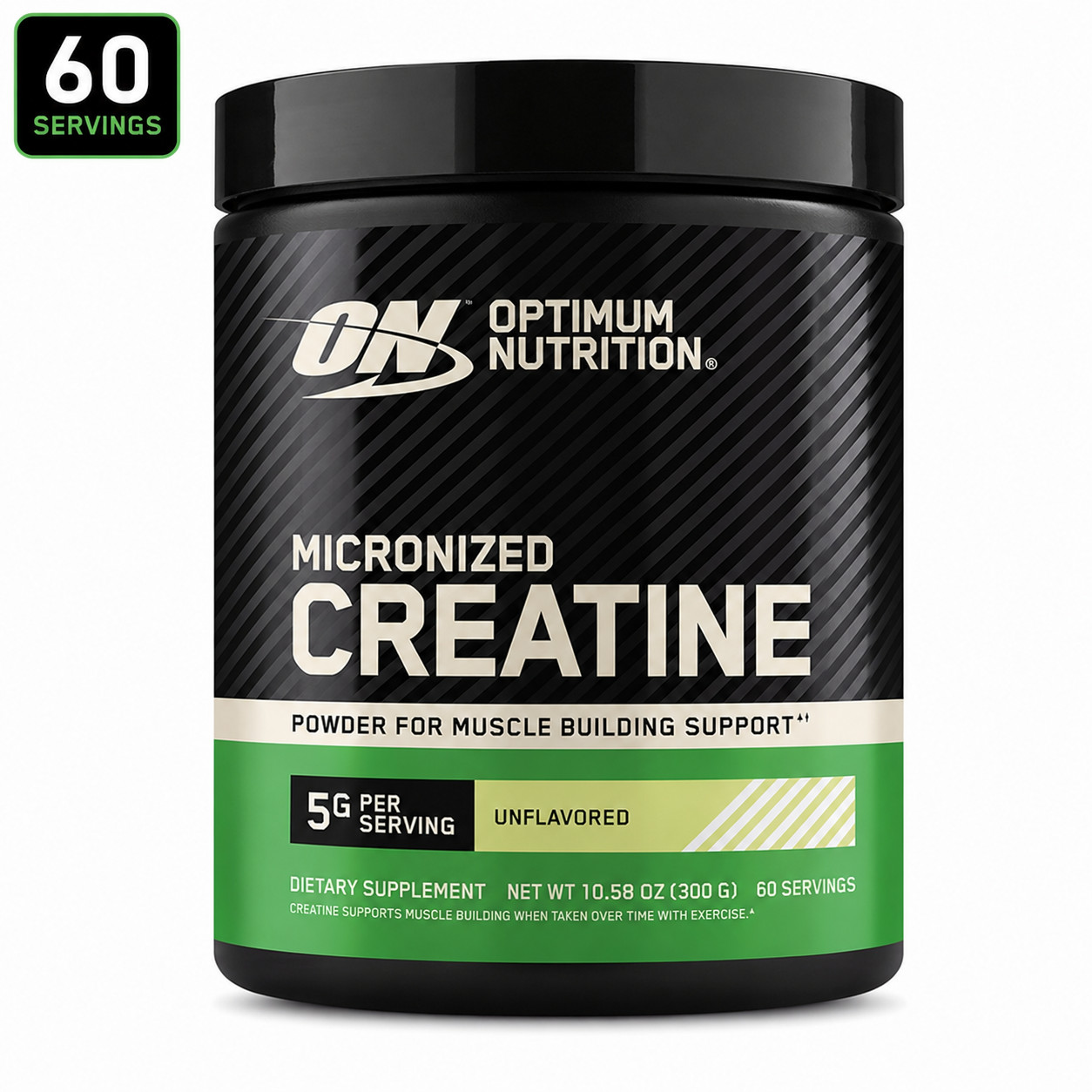

Photos from current listings. Actual item, color, and included accessories may vary.
Optimum Nutrition Creatine 2500 Buying Guide
Optimum Nutrition Creatine 2500 is a micronized creatine monohydrate capsule product (2.5 g per capsule) positioned for athletes who prefer capsules over powders; the core trade-off is capsule convenience and swallow count versus dose flexibility and cost per gram. The decisive rule: choose capsules only if you accept 2–4 capsules per 2.5–5 g daily dose and verify the label states 100% creatine monohydrate with no proprietary blends; otherwise bulk micronized powder delivers the same ergogenic effect with easier dose titration.
Key takeaways
- Active ingredient is creatine monohydrate (the only form with consistent ergogenic evidence); micronization reduces particle size for better mixability but does not change absorption or efficacy versus non-micronized monohydrate.
- Capsule dose math: each capsule delivers 2.5 g creatine monohydrate, so a standard 5 g maintenance dose requires 2 capsules and a 20 g loading phase requires 8 capsules daily.
- Capsule shells add negligible creatine but increase pill burden; powder forms deliver 5 g per rounded teaspoon with no shell or encapsulation excipients.
At a glance
- Category
- Sports Performance
- Last updated
- Nov 29, 2026
Current offers
Highlights
- Active ingredient is creatine monohydrate (the only form with consistent ergogenic evidence); micronization reduces particle size for better mixability but does not change absorption or efficacy versus non-micronized monohydrate.
- Capsule dose math: each capsule delivers 2.5 g creatine monohydrate, so a standard 5 g maintenance dose requires 2 capsules and a 20 g loading phase requires 8 capsules daily.
- Capsule shells add negligible creatine but increase pill burden; powder forms deliver 5 g per rounded teaspoon with no shell or encapsulation excipients.
- Optimum Nutrition product lines differ by dose format and serving size—capsule SKUs (2.5 g/cap) versus micronized powder (5 g/scoop)—so compare cost per gram of creatine, not cost per container.
Best use cases
- Best fit: travelers and gym-bag minimalists who want pre-measured 2.5 g creatine doses without scoops or shaker cleanup—pick the capsule SKU and plan 2 capsules per 5 g dose.
- Best fit: athletes stacking creatine with other capsule-format supplements who prefer a single pill organiser; skip if you need loading-phase doses above 10 g/day because capsule count becomes impractical.
- Wrong fit: budget-focused lifters—bulk micronized creatine monohydrate powder delivers the same 5 g dose at far lower cost per gram and allows flexible dosing; capsules are a convenience premium, not a performance upgrade.
- Wrong fit: anyone expecting creatine to act as a stimulant or pre-workout—creatine is a saturation-based supplement taken daily regardless of training time; pair with consistent hydration and 3–5 g/day maintenance.
Buying tips
- Dose math rule: 3–5 g creatine monohydrate daily maintains saturation; at 2.5 g per capsule that is 2 capsules/day maintenance and 8 capsules/day during a 5–7 day loading phase (20 g/day).
- Label rule: choose products listing creatine monohydrate as the sole active ingredient with no proprietary blends, no added stimulants, and a third-party testing mark (NSF Certified for Sport or Informed Sport) if you compete under drug-testing rules.
- Form rule: micronized monohydrate dissolves more readily in water but is chemically identical to standard monohydrate—do not pay a premium for 'micronized' if you swallow capsules, since mixability is irrelevant.
- Format rule: capsules cost more per gram than powder due to encapsulation and packaging; buy capsules only when convenience or travel justifies the premium, and buy powder when daily dose exceeds 5 g or budget matters.
Specs
| Creatine Form | Monohydrate (micronized or standard) |
|---|---|
| Dose Per Capsule | 2.5 g creatine monohydrate |
| Daily Maintenance | 3–5 g (2 capsules) |
| Loading Phase | 20 g/day (8 capsules) for 5–7 days |
Related searches
What to check before buying
- Verify the label states 2.5 g creatine monohydrate per capsule and count total capsules per container to calculate days of supply at your daily dose (e.g., 200 capsules = 100 days at 2 capsules/day).
- Confirm the product is third-party tested (NSF Certified for Sport or Informed Sport) if you are a drug-tested athlete, since creatine itself is permitted but contamination risk varies by manufacturer.
- Check capsule size and count against your willingness to swallow 2–8 capsules daily; if pill burden is a barrier, choose micronized powder instead.
- Confirm storage conditions: keep capsules dry and below 25°C/77°F; humidity can soften gelatin or HPMC shells and clump powder—store in the original sealed container.
FAQ
Data sources: eBay / Amazon listings and product attribute feeds. Updated Nov 29, 2026.
Some links on this page are affiliate links. If you buy after clicking one, we may earn a commission at no extra cost to you. This does not change which products appear here or their order. Affiliate disclosure.