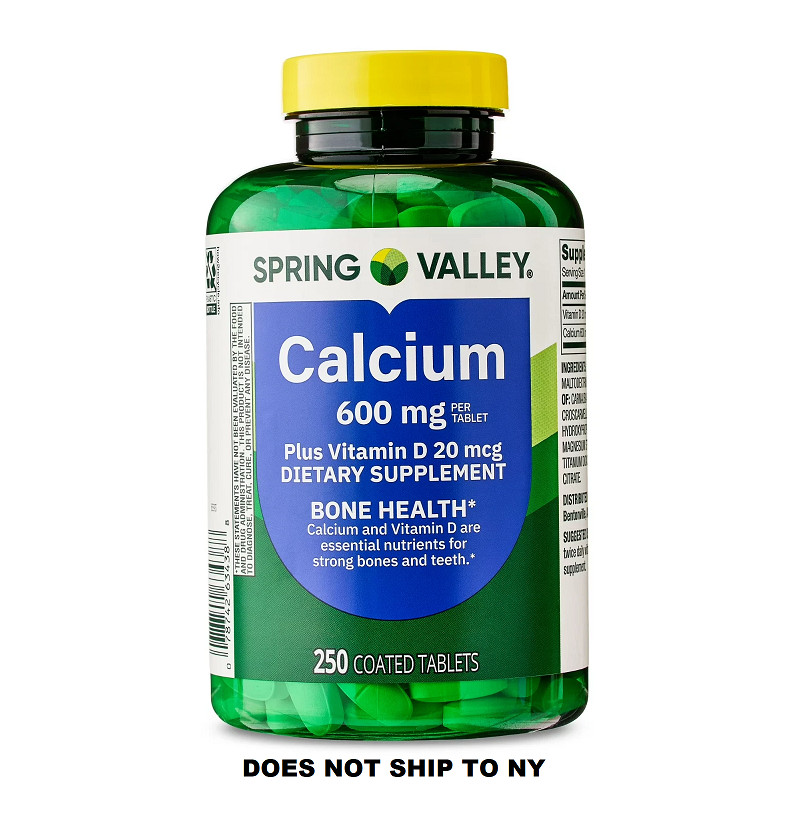

Photos from current listings. Actual item, color, and included accessories may vary.
Calcium And Vitamin D Buying Guide
Calcium and vitamin D supplements combine a mineral source (carbonate, citrate, or food-derived) with D3 or D2 to support bone density and absorption. The core trade-off is elemental calcium dose and salt form versus pill count, digestive tolerance, and absorption with or without food. Choose carbonate for cost-efficient high-dose tablets taken with meals; choose citrate or chelated forms for low-stomach-acid tolerance and flexible timing.
Key takeaways
- Calcium carbonate is 40% elemental calcium by weight, so 1200 mg of carbonate yields 480 mg elemental calcium; citrate is 21% elemental, requiring larger or more pills per dose.
- Vitamin D3 (cholecalciferol) raises serum 25(OH)D more effectively than D2 (ergocalciferol) at equivalent IU doses, making D3 the preferred form for daily maintenance.
- Absorption per dose caps around 500-600 mg elemental calcium, so split total daily intake into two doses rather than one 1200 mg elemental bolus.
At a glance
- Category
- Vitamins & Minerals
- Last updated
- Nov 28, 2026
Current offers
Highlights
- Calcium carbonate is 40% elemental calcium by weight, so 1200 mg of carbonate yields 480 mg elemental calcium; citrate is 21% elemental, requiring larger or more pills per dose.
- Vitamin D3 (cholecalciferol) raises serum 25(OH)D more effectively than D2 (ergocalciferol) at equivalent IU doses, making D3 the preferred form for daily maintenance.
- Absorption per dose caps around 500-600 mg elemental calcium, so split total daily intake into two doses rather than one 1200 mg elemental bolus.
- Carbonate requires stomach acid for dissolution and must be taken with food; citrate and malate absorb with or without meals and suit proton-pump inhibitor users.
Best use cases
- Best fit: adults needing 1000-1200 mg total daily calcium who eat regular meals — pick 600 mg elemental carbonate + 20 mcg (800 IU) D3 tablets, two per day with food.
- Best fit: older adults, PPI users, or bariatric patients with low stomach acid — pick calcium citrate plus D3, taken with or without meals, even at higher pill counts.
- Wrong fit: anyone expecting a single 1200 mg elemental calcium tablet to absorb fully — split into 500-600 mg doses or choose a twice-daily regimen instead.
- Wrong fit: buyers seeking magnesium or K2 synergy in the same pill — most calcium+D3 products omit them; buy a separate K2/Mg formula if that stack matters to you.
Buying tips
- Read the 'elemental calcium' line, not the salt weight: 1250 mg carbonate = 500 mg elemental; 950 mg citrate = 200 mg elemental. Match labels to your target dose.
- Aim for 600-800 IU (15-20 mcg) D3 per tablet so a twice-daily calcium regimen delivers 1200-1600 IU total, staying under the 4000 IU adult upper limit.
- Prefer tablets with USP, NSF, or ConsumerLab verification; unverified carbonate can fail dissolution specs and pass through undissolved.
- Choose smaller tablets or caplets in the 500-600 mg elemental range for swallowability; large 1200 mg elemental single-tablet products are hard to split and poorly absorbed.
Specs
| Calcium Form | Carbonate / Citrate / Chelated |
|---|---|
| Elemental Calcium | 500-600 mg per dose (split daily) |
| Vitamin D Form | D3 cholecalciferol (preferred) vs D2 |
| D3 Potency | 600-1600 IU per daily serving |
Related searches
What to check before buying
- Calculate your dietary calcium first: dairy, fortified plant milks, and leafy greens often supply 400-700 mg, so supplement only the 500-800 mg gap.
- Confirm your total vitamin D intake including multivitamins and sun exposure stays below 4000 IU/day before adding a D3-fortified calcium product.
- Check for interactions with levothyroxine, iron, and certain antibiotics — calcium must be separated by 2-4 hours from these medications.
- If you take acid reducers (PPIs, H2 blockers) or have had gastric surgery, select citrate or chelated calcium rather than carbonate.
FAQ
Data sources: eBay / Amazon listings and product attribute feeds. Updated Nov 28, 2026.
Some links on this page are affiliate links. If you buy after clicking one, we may earn a commission at no extra cost to you. This does not change which products appear here or their order. Affiliate disclosure.