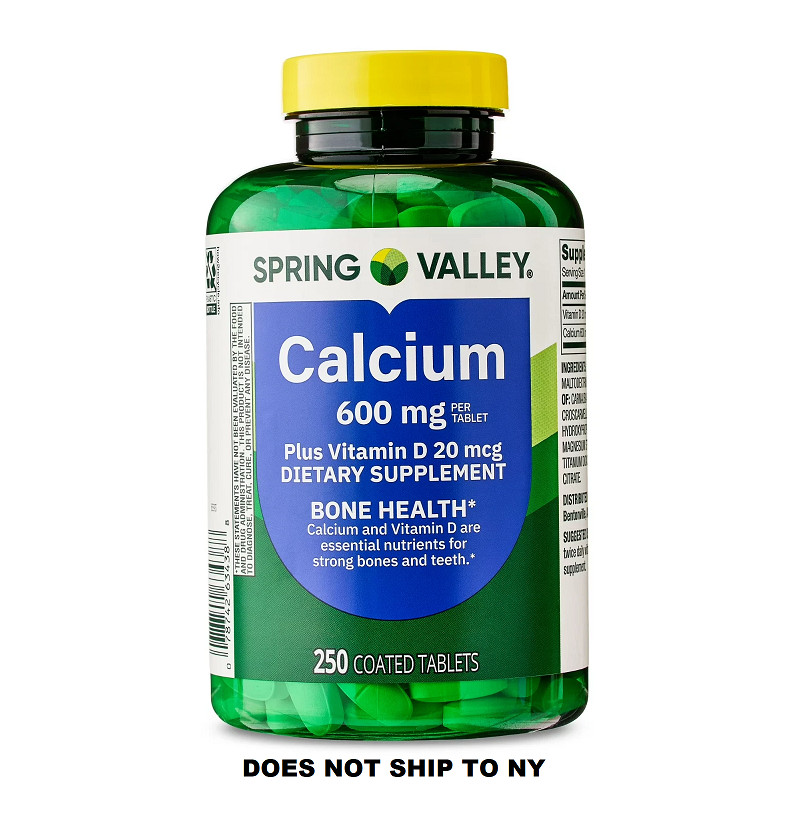

Photos from current listings. Actual item, color, and included accessories may vary.
Calcium Vitamin D Buying Guide
Calcium + vitamin D supplements combine a calcium salt (carbonate or citrate) with D3 to support bone density and absorption. The key trade-off is elemental calcium per dose and salt form: carbonate delivers 40% elemental calcium but requires stomach acid, while citrate delivers 21% and absorbs without food. Choose carbonate for cost-effective, food-timed dosing; choose citrate for low-acid users or those who dose away from meals—never accept vague 'bone health' blends without disclosed elemental calcium and D3 IU.
Key takeaways
- Calcium carbonate is 40% elemental calcium by weight; calcium citrate is 21%—a 1200 mg carbonate dose yields 480 mg elemental calcium.
- Vitamin D3 (cholecalciferol) is the preferred form for raising serum 25(OH)D; 20 mcg equals 800 IU, and 1600 IU is a common upper daily tier.
- Carbonate requires gastric acid for dissolution and must be taken with food; citrate absorbs independently of meals and suits proton-pump inhibitor users.
At a glance
- Category
- Vitamins & Minerals
- Last updated
- Nov 28, 2026
Current offers
Highlights
- Calcium carbonate is 40% elemental calcium by weight; calcium citrate is 21%—a 1200 mg carbonate dose yields 480 mg elemental calcium.
- Vitamin D3 (cholecalciferol) is the preferred form for raising serum 25(OH)D; 20 mcg equals 800 IU, and 1600 IU is a common upper daily tier.
- Carbonate requires gastric acid for dissolution and must be taken with food; citrate absorbs independently of meals and suits proton-pump inhibitor users.
- The tolerable upper intake for calcium is 2000–2500 mg/day elemental; split doses to 500 mg or less per sitting for maximal absorption.
Best use cases
- Best fit: adults taking a 600 mg carbonate + 20 mcg D3 tablet twice daily with meals for routine bone support at low cost.
- Best fit: older adults or those on acid-reducing medication choose calcium citrate + D3 to ensure absorption without stomach acid.
- Wrong fit: anyone seeking a single mega-dose above 500 mg elemental calcium per sitting—absorption drops sharply; split doses instead.
- Skip: gummy or 'bone blend' products that list total salt weight without elemental calcium or D3 IU on the label.
Buying tips
- Read the elemental calcium line, not the salt weight: 1200 mg carbonate = 480 mg elemental; 1200 mg citrate = 252 mg elemental.
- Match D3 IU to need: 800 IU (20 mcg) for maintenance; 1600 IU suits higher-deficiency risk—confirm your 25(OH)D lab before exceeding 2000 IU/day.
- Choose carbonate if you eat regular meals and want the lowest cost per elemental milligram; choose citrate if you dose on an empty stomach or use PPIs.
- Verify the label states D3 (cholecalciferol) rather than D2 (ergocalciferol); D3 has superior retention and is the standard in bone-health regimens.
Specs
| Calcium Salt | Carbonate (40% elemental) vs Citrate (21%) |
|---|---|
| Elemental Calcium | 480 mg per 1200 mg carbonate dose |
| Vitamin D Form | D3 cholecalciferol / 20-40 mcg (800-1600 IU) |
| Dosing Frequency | Split to ≤500 mg elemental per sitting |
Related searches
What to check before buying
- Calculate your total daily elemental calcium from diet plus supplement—aim under 2000 mg/day and split into 500 mg or smaller doses.
- Confirm the tablet size and count: carbonate 600 mg tablets often require two per dose, so a 250-count bottle is roughly a 4-month supply at 1200 mg/day.
- Check for a USP or NSF verification mark to confirm the product dissolves and contains the labeled elemental calcium and D3.
- If you take thyroid medication, iron, or certain antibiotics, separate calcium doses by at least 2 hours to avoid absorption interference.
FAQ
Data sources: eBay / Amazon listings and product attribute feeds. Updated Nov 28, 2026.
Some links on this page are affiliate links. If you buy after clicking one, we may earn a commission at no extra cost to you. This does not change which products appear here or their order. Affiliate disclosure.